
The 2026 Reality: Your Invoice Rarely Matches Your Quote
If you run an e-commerce store in 2026, you’ve probably noticed that your actual shipping invoices consistently exceed the rates shown at checkout. This gap isn’t random — it’s the result of several overlapping surcharge mechanisms that carriers have made increasingly complex over the past three years.
According to published carrier rate guides, the combination of fuel surcharges, dimensional weight adjustments, and residential delivery fees means that most merchants pay between 10% and 25% more than their base rate on any given shipment. The problem isn’t that these fees are hidden — they’re documented in carrier tariff sheets. The problem is that few merchants have the time to cross-reference every invoice line against those documents.
That’s exactly why performing a regular E-commerce Shipping Audit is essential in 2026. »
Table of Contents
Where the Gap Between Quote and Invoice Comes From
Understanding the three main sources of billing discrepancies is the first step toward closing them.
1. Dimensional Weight (DIM) Pricing
UPS, FedEx, and DHL calculate shipping cost based on whichever is greater: actual weight or dimensional weight. Dimensional weight is calculated by dividing the box volume (L × W × H in inches) by a divisor — currently 139 for most domestic ground services. If you’re shipping a lightweight product in a box that’s larger than necessary, you’re paying for air. A packaging audit alone — simply right-sizing your boxes — can reduce DIM charges significantly without changing your carrier or negotiating any new rates.
2. Address Correction and Residential Surcharges
Carriers use automated systems to verify delivery addresses at time of transit, not at time of booking. If a customer enters an address that gets flagged as residential, or if there’s a minor formatting inconsistency, you can be charged a correction or reclassification fee ranging from $5 to $18 per package. These fees appear as line items on monthly statements and are easy to miss if you’re not looking for them.
3. Fuel and Peak Season Surcharges (+15% Coefficient)
As of February 2026, major carriers apply a dynamic fuel surcharge that updates on a weekly or bi-weekly cycle. On most domestic routes, this adds approximately 15% on top of the base rate. Unlike the DIM and address fees, this one is unavoidable — but it should be factored into your shipping cost projections. If your pricing model was built on pre-surcharge rate data, your margin calculations are likely off.
Steps to conduct your E-commerce Shipping Audit
You don’t need specialized software to identify where your money is going. This framework works with a standard spreadsheet export from your carrier account.
Step 1: Export and Compare
Pull your last 30 days of shipping data. Create two columns: Base Rate (the quoted price) and Total Billed (what you actually paid). Calculate the difference as a percentage. If the gap is consistently above 20%, you have a systemic surcharge issue worth investigating further.
Step 2: Map Your Shipping Zones
Zone-based pricing means that the distance between your fulfillment location and your customer has a direct impact on cost. If a significant portion of your orders are shipping to Zone 6, 7, or 8 from a single East Coast warehouse, redistributing inventory to a central or West Coast location — even partially — can reduce your average zone and meaningfully lower your per-package cost.
Step 3: Benchmark Against Available Rates
Once you know what you’re currently paying, compare it against rates available through third-party platforms. The difference between default Shopify carrier rates and negotiated rates on platforms like Pirate Ship or Easyship is often 20–35% on standard package sizes.
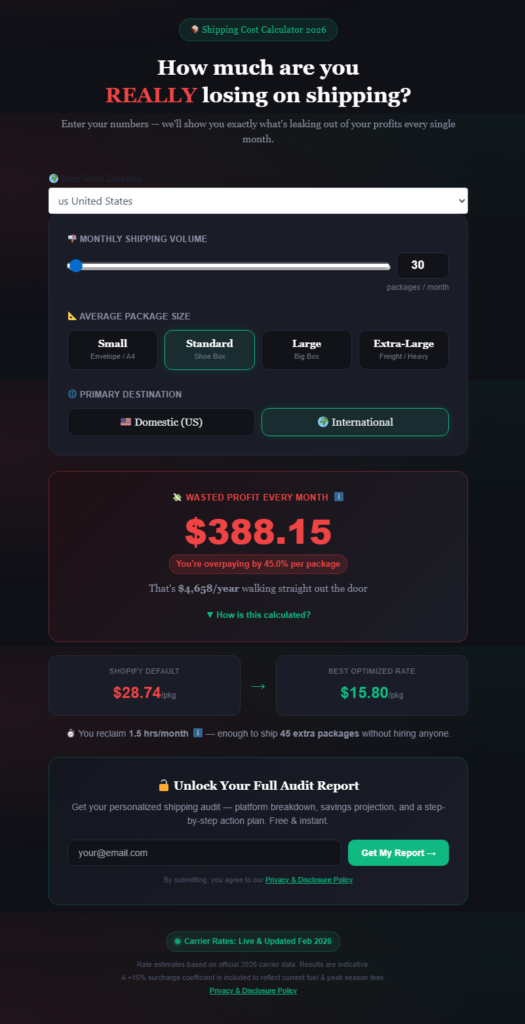
💡 To run this comparison automatically: Our Free 2026 E-commerce Shipping Audit Calculator applies current surcharge coefficients to your shipping profile and shows you the gap between your current rate and the best available rate across major platforms.
Platform Options After Your Audit
Once you’ve identified the savings opportunity, the next step is moving to a platform that offers better-negotiated rates. Here’s a factual breakdown of the main options available in 2026:
Pirate Ship — No monthly fees, no markup on rates. Offers USPS and UPS rates at the « Below Commercial Plus » tier, which is the deepest publicly available discount on both carriers. Best fit for merchants shipping under 5,000 packages per month domestically. Try Pirate Ship →
Easyship — Strong on international routes and freight. Connects to 250+ carriers globally and handles customs documentation. Best fit for merchants with a significant international volume or oversized shipments. Try Easyship →
ShipStation — Multi-channel automation platform. Allows you to set rules that automatically route each package to the least-cost carrier based on destination, weight, and dimensions. Best fit for high-volume merchants selling across multiple platforms (Shopify, Amazon, Walmart). Try ShipStation →
SendCloud — Focused on European fulfillment. Integrates with regional carriers including DPD, DHL Parcel Europe, and Royal Mail. Best fit for brands expanding into EU markets in 2026.
Conclusion: Your 2026 E-commerce Shipping Audit
Shipping is typically the second or third largest variable cost for an e-commerce business. Running a quarterly audit — comparing what you’re paying against what’s available — is a straightforward way to identify savings without renegotiating contracts or changing your operations significantly.
The three areas to check first: DIM weight (packaging efficiency), address surcharges (data quality), and your base rate platform (are you on the best available tier?).
FAQ
Why audit shipping costs in 2026 specifically?
Carrier fee structures have become more complex, with fuel surcharges now updating weekly rather than monthly. Rates that were accurate in 2024 or 2025 may no longer reflect what you’re actually being billed.
How much can a typical Shopify merchant realistically save?
Based on published rate comparisons between Shopify’s default carrier pricing and negotiated platform rates, most merchants can reduce per-package costs by 15–35% depending on package size and destination.
Does Pirate Ship have hidden fees?
No. Pirate Ship passes through negotiated rates without adding a monthly subscription or per-label markup. This is documented in their published pricing model.
Rates referenced in this article are based on published 2026 carrier tariffs and platform pricing as of February 2026. Actual rates may vary based on account type, volume, and destination.