
One is built like an operations hub, the other like a shipping layer. Pick wrong and you either pay for power you’ll never switch on, or cap your growth at the moment it starts. The split is cleaner than the feature lists suggest — and one of these two doesn’t have the free plan its app listing advertises.
Volume decides, and the entry price is not what either pricing page suggests. Shippo wins between roughly 50 and 500 orders a month: a genuinely free plan up to 30 labels, then $17/month to 200 labels and $29 to 500, with API access on every tier. ShipStation wins past 500 orders or across multiple sales channels, where its automation depth and multi-store consolidation earn back the subscription — but budget honestly, because it has no permanent free plan (despite “Free plan available” appearing on its Shopify App Store listing), its $14.99 Starter tier excludes the API and your own carrier accounts, and the real entry point for most stores is Standard at $29.99, reaching $89.99 at 500 shipments. At the 500-label mark the subscription gap is $29 against $89.99 — about $732 a year for consolidation you may not need. Below 50 orders, neither: Pirate Ship is free and enough, and we earn nothing recommending it.
| Shippo | ShipStation | |
|---|---|---|
| Best for | Single-channel US stores, 50–500 orders/mo | 500+ orders/mo, multi-channel, warehouse ops |
| Free plan | Yes — up to 30 labels/month, permanent | None. 30-day trial only, no card required |
| Paid entry | $17/mo (≤200 labels) · $29 (≤500) · $199 (≤10,000) | $14.99 Starter · $29.99 Standard · $349.99 Premium |
| Cost at 500 shipments | $29/month | $89.99/month |
| API access | Every plan, free tier included | Standard and above only ($29.99+) |
| Own carrier accounts | Any plan · $0.05/label fee on the free tier | Standard and above only |
| Users included | 1 on free, team logins on Pro | 3 on Starter (hard cap) · 10 Standard · 15 Premium |
| Multi-channel | Works, but built Shopify-first | The core product: Shopify, Amazon, eBay, Etsy, Walmart |
| Annual discount | 10% off | 20% off |
| Try Shippo free → | Start 30-day trial → |
Prices verified September 3, 2026 against both platforms’ published pricing and independent trackers. Both bill by volume step, so two stores on the same plan name can pay different amounts — confirm your step before budgeting. Full ladders: ShipStation · Shippo.
The Real Difference: an Operations Hub vs a Shipping Layer
Strip away the feature lists and the two products have different DNA. ShipStation is an operations hub: it wants to be where every order — Shopify, Amazon, eBay, Etsy, Walmart — lands, gets processed through automation rules, and leaves as a label. Shippo is a shipping layer: it plugs into your store, compares carrier rates per shipment, and prints labels without trying to run your back office.
That’s why “which is better” is the wrong question. A 2,000-order multi-channel operation would suffocate in Shippo’s simplicity; a 100-order Shopify store would drown in ShipStation’s configuration screens and pay for the privilege. Volume and channel mix decide.
The Free Plan That Isn’t
Here’s the detail that changes how you should read ShipStation’s pricing. Its Shopify App Store listing shows “Free plan available” — and there is no free plan. What exists is a 30-day trial, no credit card required, after which you’re on a paid tier starting at $14.99. Shippo’s free plan, by contrast, is permanent: 30 labels a month, one user, full commercial rates, no card.
The second thing the entry price hides: ShipStation’s $14.99 Starter tier excludes API access and the ability to connect your own negotiated carrier accounts. Both unlock at Standard, $29.99. If your checkout needs live rates, or you’ve negotiated your own carrier contract, Starter cannot do it at any volume — which makes $29.99, not $14.99, the honest starting price for most stores. Shippo includes API access on every tier, free plan included.
One point in ShipStation’s favour worth stating plainly: carrier connection fees were eliminated for accounts created after July 8, 2025. Merchants still on legacy plans may be paying per-carrier charges that upgrading removes — worth checking your invoice if you’ve been a customer since before then.
Shippo — the flexible shipping layer
Shippo keeps the deep USPS and UPS commercial discounts and adds what a growing single-store operation actually needs: multi-carrier rate comparison per shipment, batch printing, and automation — without a subscription wall in front of the essentials. It also surfaces USPS Cubic automatically when a parcel qualifies, which retail channels don’t sell at all.
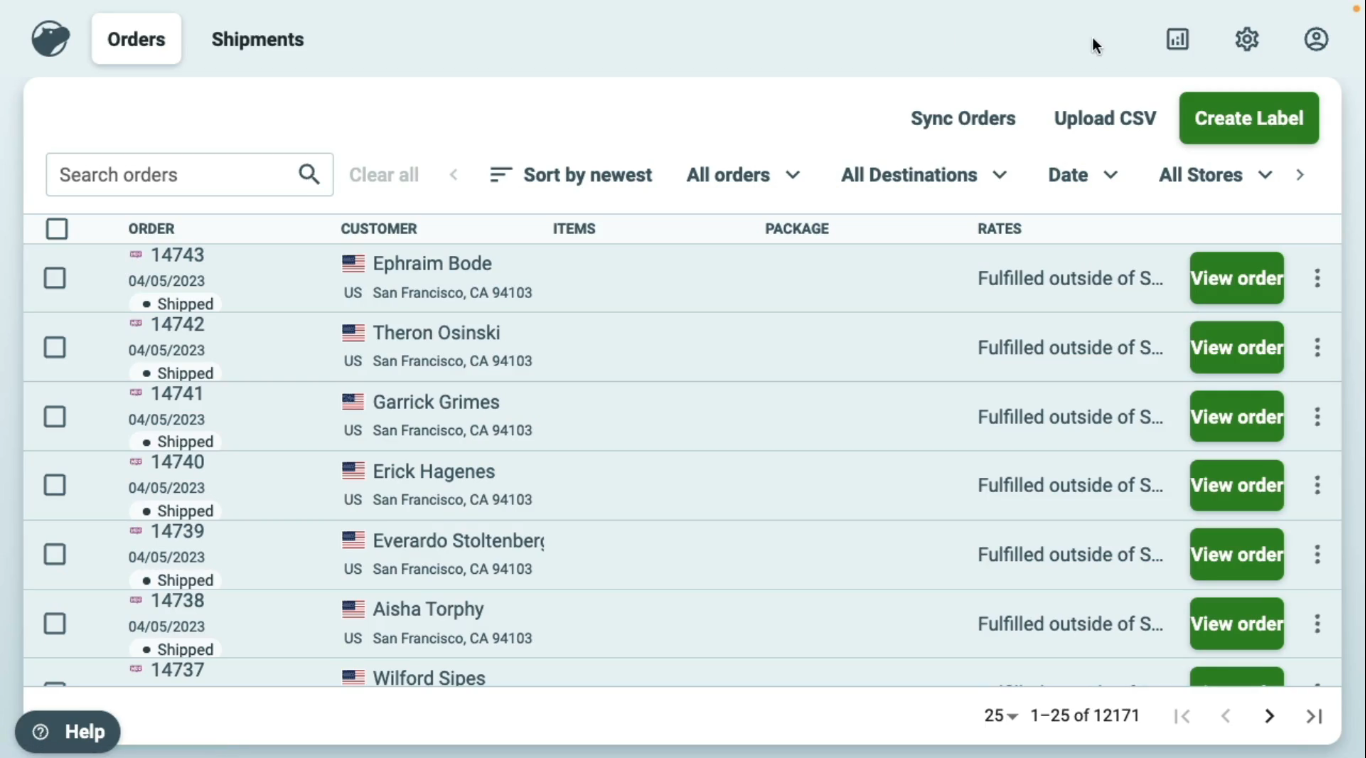
Best for: single-channel US stores shipping 50–500 orders a month.
Cost: free up to 30 labels/month, then $17 (≤200), $29 (≤500), scaling to $199 (≤10,000). 10% off annually. Full pricing breakdown.
Pros:
- A permanent free plan that’s genuinely usable at 30 labels a month
- API on every tier — live checkout rates without a plan upgrade
- Cheapest paid entry in the category at $17, and $29 where ShipStation charges $89.99
- Per-shipment multi-carrier rate shopping with USPS Cubic surfaced automatically
- Onboarding measured in hours
Cons:
- Automation is functional, not deep — no rule engine on ShipStation’s level
- No native inventory or warehouse management: it ships, it doesn’t operate
- A $0.05 per-label fee applies on the free plan if you connect your own carrier accounts — past roughly 340 such labels, the paid plan is cheaper than free
- Support responsiveness is a recurring merchant complaint
ShipStation — the high-volume workhorse
ShipStation assumes shipping is an operation with staff, rules and exceptions. Multi-store and multi-channel management, rule-based automation (assign carrier by weight, destination, SKU or tag), batch workflows, and the reporting you need once every cent per label matters at scale. Reviewers with heavy manual workflows report the largest wins — one describes cutting a four-hour daily routine to a single click.
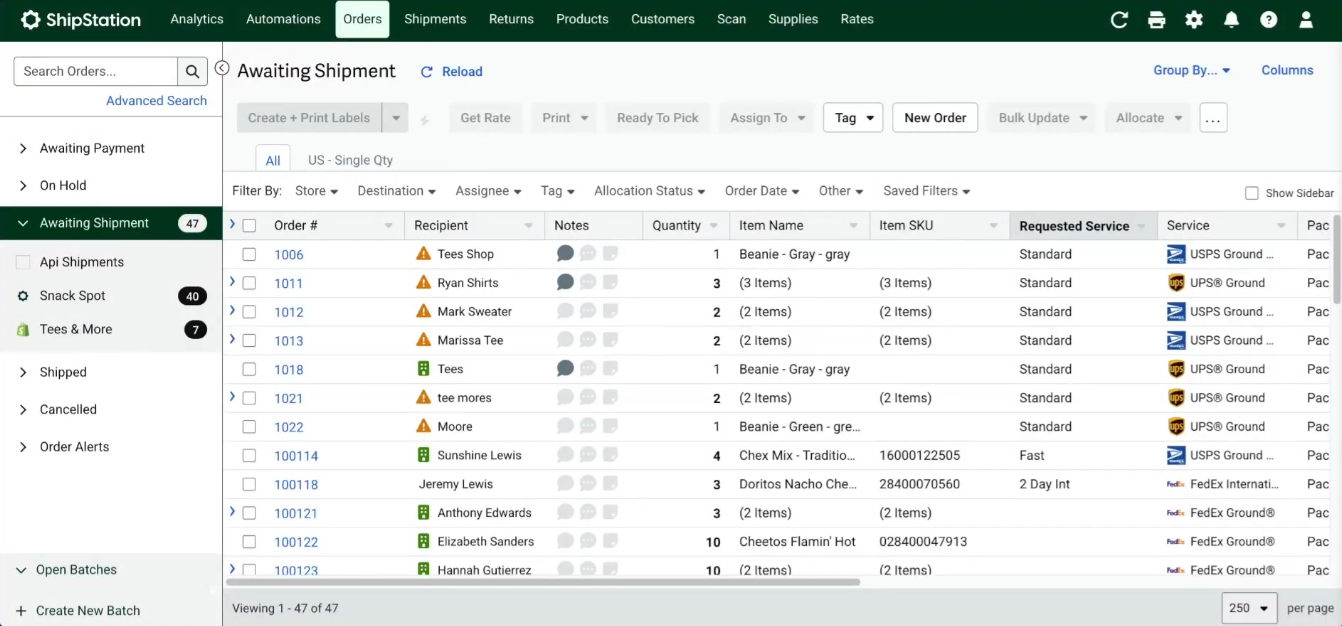
Best for: stores shipping 500+ orders a month, multi-channel sellers, and operations with warehouse workflows.
Cost: $14.99–$174.99 Starter, $29.99–$3,599.99 Standard, $349.99+ Premium — volume-stepped, so $89.99 at 500 shipments and $149.99 at 1,000. 20% off annually, 30-day trial, 90-day satisfaction guarantee. Full pricing ladder.
Pros:
- The deepest automation of the two — rules, tags and batch workflows built for teams
- True multi-channel consolidation: every marketplace in one queue
- Published pricing through 100,000 monthly shipments, no contact-sales gate
- Broad carrier network including FedEx, DHL and GlobalPost alongside USPS and UPS
Cons:
- No permanent free plan, despite what its App Store listing says
- Starter excludes the API and own-carrier accounts, and hard-caps at 3 users — budget Standard from day one
- The July 2025 restructure raised legacy prices sharply: 1,000 monthly shipments went from $59.99 to $149.99
- Real learning curve, and reliability complaints — six logged incidents across June and July 2026
- Overkill below ~500 orders a month
Start your ShipStation 30-day trial →
The subscription is the small number
Postage dwarfs it. Run the free audit with your volume, package size and destination to see what commercial-tier rates change before you pick a platform. 30 seconds, no signup.
Run Your Free Audit →How to Choose: Three Questions Settle It
1 — Do you sell on more than one channel?
- Yes → ShipStation. Consolidation is what you’re buying, and Shippo doesn’t replicate it.
- No → question 2.
2 — How many orders a month?
- Under 50 → neither. Pirate Ship is free and enough — we earn nothing recommending it. When free stops being enough.
- 50–500 → Shippo, at $17 or $29 against $29.99 or $89.99.
- 500+ → ShipStation, where automation depth starts earning its keep.
3 — Does your checkout need live rates via API?
- Yes, on a budget → Shippo: API on every plan, free tier included.
- Yes, at scale → ShipStation Standard minimum. Starter cannot do it at any volume.
Notice what’s absent: feature counts, dashboard aesthetics, marketing claims. Channel mix, volume and API needs decide. If you’re weighing either against Shopify’s built-in tool rather than against each other, that comparison is here.
Frequently Asked Questions
Is Shippo cheaper than ShipStation?
At every published volume step, yes on subscription: free versus none at low volume, $17 versus $29.99 at entry, and $29 versus $89.99 at 500 shipments — about $732 a year apart at that level. The label rates themselves are broadly similar since both resell the same carrier discounts. ShipStation earns its premium in labour saved, not in postage.
Does ShipStation have a free plan?
No. Its Shopify App Store listing displays “Free plan available”, but what exists is a 30-day trial with no credit card required, followed by a paid tier from $14.99. A 90-day satisfaction guarantee covers paid subscriptions. Shippo’s free plan is permanent at up to 30 labels a month.
Why is ShipStation’s $14.99 plan not the real entry price?
Because Starter excludes API access and the ability to connect your own negotiated carrier accounts, and hard-caps at three users. Both unlock at Standard, $29.99. For most stores considering ShipStation at all, Standard is the honest budget line — treating $14.99 as the price sets up a forced upgrade within weeks.
Can I switch from Shippo to ShipStation later?
Yes, and it’s a common growth path. Both connect to Shopify natively, so switching means connecting the new platform and re-mapping your shipping presets — an afternoon, not a migration project. Your carrier accounts and Shopify order history are untouched. The full switching guide covers the mechanics.
Do Shippo and ShipStation offer the same carrier discounts?
Both provide pre-negotiated commercial rates that beat retail by a wide margin — our rate compilation measures a 35–50% gap against Shopify’s default pricing for either platform. ShipStation reaches further on carriers (FedEx, DHL, GlobalPost); Shippo surfaces USPS Cubic automatically. The difference isn’t the discount, it’s what you can do around it.
What if I ship fewer than 50 orders a month?
Then neither is your starting point. Pirate Ship is free with the same USPS commercial rates and no volume cap, and we earn nothing recommending it. Shippo becomes worth it once batch printing and rate shopping start saving real time; ShipStation once you pass ~500 orders or add channels. The progression is mapped in Shippo vs Pirate Ship.