
Most “Sendcloud vs ShipStation” pages compare feature lists. That misses the point: these two platforms were built for different continents. Get the geography right and the choice makes itself — and in 2026, a customs reform made that geography matter more than it did last year.
This is a geographic decision before it’s a functional one. Ship from Europe — Austria, Belgium, France, Germany, Italy, the Netherlands, Spain or the UK — and it’s Sendcloud: 160+ European carriers including the national posts and regional networks US platforms don’t carry, plus the pickup points and returns flows EU buyers expect, and a genuinely free forever tier to start on. Ship from the US and it’s ShipStation: deeper automation, true multi-channel consolidation, and the US carrier discount stack — but note it has no free plan at all, only a 30-day trial, and its $14.99 Starter tier excludes API access and your own carrier accounts, making $29.99 the realistic entry. Neither platform is a compromise on the other’s home ground; each simply limps abroad.
| Sendcloud | ShipStation | |
|---|---|---|
| Best for | Stores shipping from Europe | US stores, 500+ orders/mo, multi-channel |
| Supported origins | AT, BE, FR, DE, IT, NL, ES, UK | US-first, with global carrier reach |
| Carrier depth | 160+ EU carriers, national posts and local networks | USPS, UPS, FedEx, DHL, GlobalPost |
| Free plan | Yes — forever tier, capped labels and integrations | None. 30-day trial only, no card required |
| Paid entry | Subscription + per-label + monthly allowance — figures on their pricing page | $14.99 Starter (no API, no own carriers) · $29.99 Standard realistic |
| Signature strength | Pickup points, returns portal, EU checkout, customs documents | Rule-based automation and multi-channel consolidation at scale |
| Try Sendcloud free → | Start the 30-day trial → |
Verified September 2026. We don’t republish Sendcloud’s rates — they’re country-specific and confidential under partner terms; see how its pricing is structured and its official page for figures. ShipStation’s full ladder: what it actually costs.
Two Platforms, Two Continents
Sendcloud was built in Eindhoven for European e-commerce: its carrier network runs deep into national posts and regional couriers — DPD, GLS, Bpost, local last-mile networks — and its features mirror how Europeans buy. Pickup-point selection at checkout, multi-language tracking, and a self-service returns portal, because EU consumer law and buying habits make returns a first-class flow rather than an exception.
ShipStation was built in Austin for American volume: multi-channel order consolidation across Shopify, Amazon, eBay, Etsy and Walmart, a rule-based automation engine that assigns carriers by weight, destination, SKU or tag, and the USPS, UPS and FedEx discount stack. Its European coverage exists; its European depth doesn’t.
That’s why feature-table comparisons miss. Each platform dominates the other on its home continent. The only real question is where your parcels start their journey — and if the answer is “both”, the honest advice is to run each origin as its own decision rather than forcing one tool to cover both.
What 2026 Changed for This Decision
One event made the geographic split sharper. On July 1, 2026, the EU abolished its €150 duty-free exemption, replacing it with a temporary flat €3 customs duty per item — per tariff line, charged to the seller rather than collected from the customer. More consequentially for platform choice: item-level customs declarations are now mandatory for every B2C shipment, with or without IOSS, and without IOSS parcels must clear in the destination member state instead of centrally.
Generating compliant item-level customs data on every parcel is platform work. Both platforms produce customs documentation, but for an EU-origin store shipping across borders routinely, Sendcloud’s EU-native handling and its IOSS-aware flows are built around exactly this problem. A further deadline sits ahead: product identifier data becomes mandatory on November 1, 2026. The full picture is in our 2026 cross-border guide.
Sendcloud — the European answer
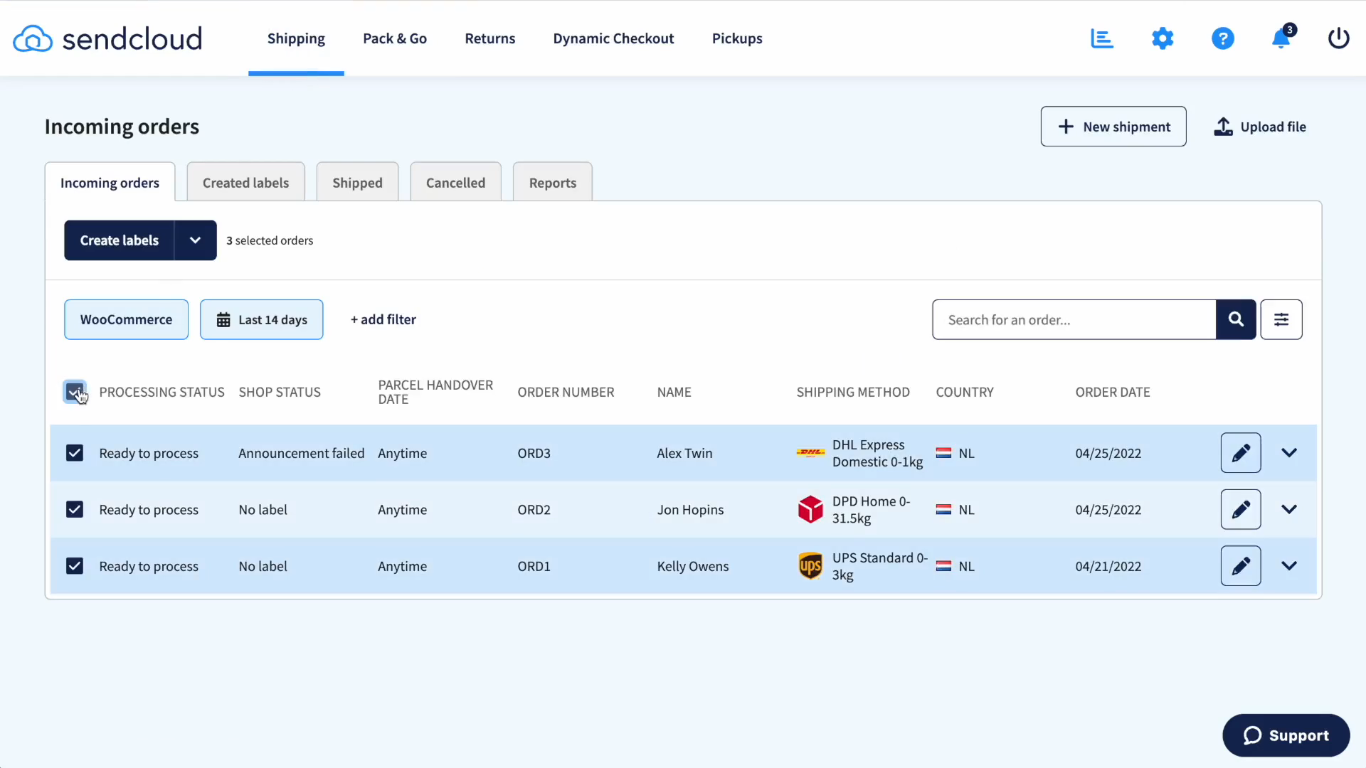
Best for: stores shipping from the eight supported European origins.
Cost: a genuine free forever plan, then paid tiers combining a subscription, a per-label component and a monthly label allowance. How the structure works.
Pros:
- 160+ European carriers, including the local networks US platforms simply don’t carry
- Pickup points, multi-language tracking and a returns portal built in — the EU buyer experience, not an add-on
- Customs documents generated from order data, which matters more since July 2026 than it ever did
- A free plan you can test on real orders, with no countdown
Cons:
- Not built for US-based stores — the carrier depth is European and the supported origins are all in Europe
- Automation rules start on paid tiers; the free plan prints labels and nothing more
- Per-country carrier contracts can add setup steps for multi-country operations, and some member states levy national clearance fees no platform removes
Full assessment: our Sendcloud review.
ShipStation — the US volume machine
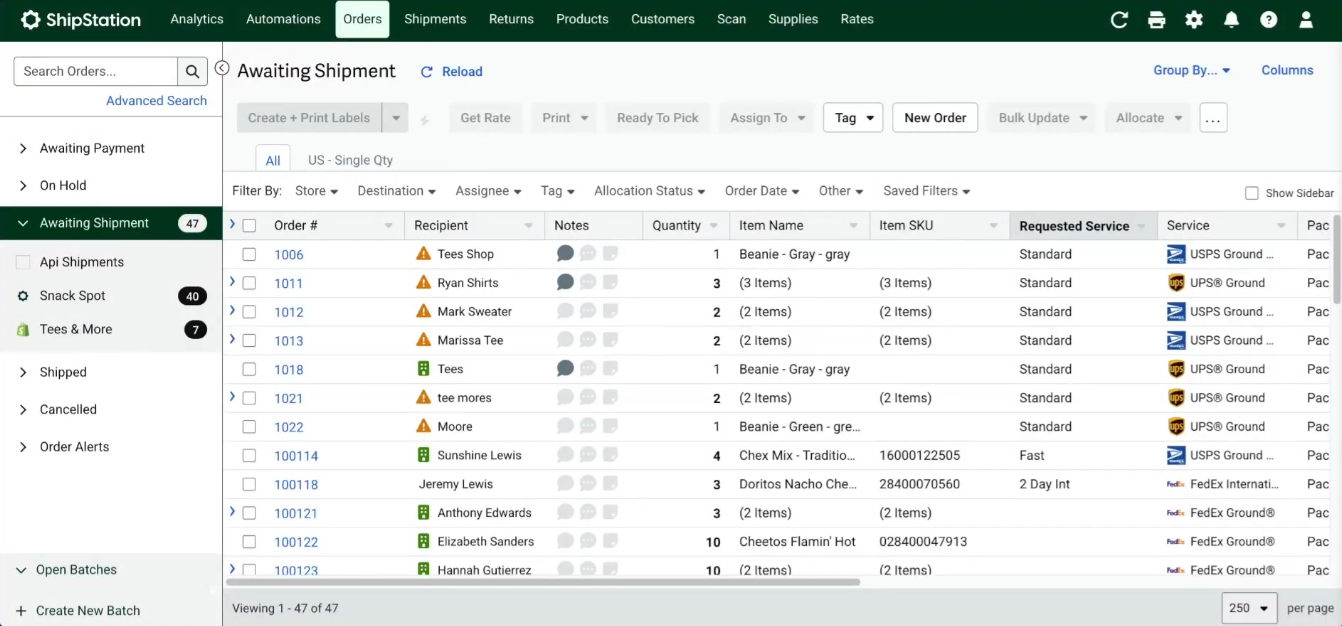
Best for: US stores shipping 500+ orders a month, multi-channel sellers, freight and oversized profiles.
Cost: no free plan — a 30-day trial with no card, then $14.99 Starter, $29.99 Standard, $349.99 Premium, volume-stepped to $89.99 at 500 shipments. Full ladder.
Pros:
- The deepest automation of the mainstream platforms — rules, tags and batch workflows built for teams
- True multi-channel consolidation: every marketplace in one queue
- US carrier discount stack plus the freight handling lighter platforms don’t attempt
- Published pricing through 100,000 monthly shipments, with no contact-sales gate
Cons:
- No permanent free tier at all, where Sendcloud has one
- Starter excludes API access and your own carrier accounts and caps at three users — budget Standard from day one
- European carrier depth doesn’t approach Sendcloud’s local coverage
- Real learning curve, and overkill below ~500 orders a month
Full assessment: our ShipStation review.
Not sure your profile is as clear-cut?
Run the free shipping audit — origin, volume, package size — and see which platform your numbers point to, plus your current overpayment. No signup needed.
Run Your Free Audit →How to Choose: One Question, Then Two
1 — Where do your parcels start?
- Europe → Sendcloud. Full stop: local carrier depth wins, and it starts free.
- United States → question 2.
- Both origins → run each as its own decision. Hybrid setups are normal and neither platform penalises it.
2 — US origin: how much do you ship?
- Under 50 orders/month → neither. Pirate Ship is free and enough, and we earn nothing recommending it.
- 50–500 → Shippo, at a third of ShipStation’s cost at that volume. The head-to-head.
- 500+ or multi-channel → ShipStation, where the automation earns its keep.
If you’re comparing either against Shopify’s built-in tool rather than against each other, that comparison is here.
Frequently Asked Questions
Can I use Sendcloud in the United States?
No. Sendcloud’s shipping origins are the eight European countries it supports: Austria, Belgium, France, Germany, Italy, the Netherlands, Spain and the UK. If your parcels originate in the US, it’s the wrong tool. If you run both EU and US warehouses, treat each origin as its own platform decision.
Does ShipStation have a free plan?
No — a 30-day trial with no card required, plus a 90-day satisfaction guarantee, then a paid tier from $14.99. Its Shopify App Store listing shows “Free plan available”, which refers to the trial. Sendcloud, by contrast, has a genuine forever free tier with a monthly label cap.
Is Sendcloud really free?
The free plan is a genuine forever tier — no subscription, and you pay only for the labels you generate at Sendcloud’s rates. Its limits are functional: a monthly label cap, limited integrations, no automation rules and no own-carrier contracts. It’s the right way to test the carrier network on live orders. Structure: what unlocks at each tier.
Which is cheaper, Sendcloud or ShipStation?
On their home continents, each wins: Sendcloud surfaces local EU carrier rates ShipStation can’t access, and ShipStation’s US discount stack outperforms Sendcloud’s US options. Our rate compilation measures the platform-versus-default gap at 35–50% per label — which platform captures it depends entirely on your origin.
Do both work with Shopify?
Yes, both integrate natively with order sync and tracking written back. Sendcloud adds EU-specific checkout options — pickup points and delivery choices; ShipStation treats Shopify as one channel among several marketplaces. Switching to either breaks nothing.